Date of Judgment: 10 December 2025
Case: Dr. Sohail Malik v. Union of India (Civil Appeal No. 404 of 2024)
Court: Supreme Court of India
Facts of the Case
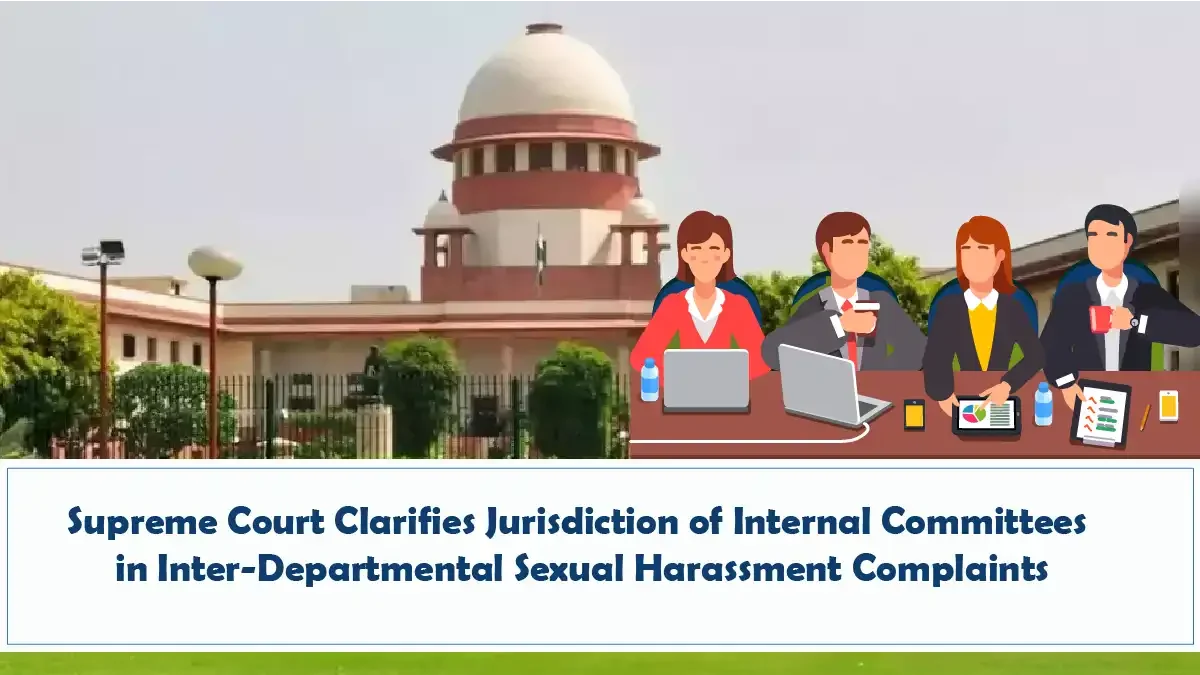
The Supreme Court was hearing an appeal challenging orders of the Central Administrative Tribunal (CAT) and the Delhi High Court concerning the jurisdiction of an Internal Committee (IC) under the Sexual Harassment of Women at Workplace (Prevention, Prohibition and Redressal) Act, 2013 (POSH Act). The aggrieved woman, a 2004-batch IAS officer posted as Joint Secretary, Department of Food and Public Distribution, alleged that she was sexually harassed on 15 May 2023 at her workplace in Krishi Bhawan, New Delhi. The respondent, a 2010-batch IRS officer then posted as OSD (Investigation), Central Board of Direct Taxes, belonged to a different department of the Central Government. An FIR was registered the next day, followed by a written complaint under Section 9 of the POSH Act before the IC of her department.
The respondent raised a jurisdictional objection and argued that, since he was an employee of another department, only the IC constituted under his controlling authority could inquire into the complaint. He relied on the wording of Section 11 of the POSH Act to contend that the inquiry must be conducted “where the respondent is an employee.” The CAT rejected this argument, and the High Court affirmed this view, prompting the present appeal.
Court’s Findings
The Supreme Court undertook a detailed textual and purposive interpretation of the POSH Act. The Court held that the phrase “where the respondent is an employee” in Section 11 does not refer to the location of the respondent’s workplace. Instead, the Court clarified that the word “where” functions as a conditional trigger—meaning “in case the respondent is an employee”—and determines only which service rules apply, not which IC has jurisdiction.
The Court emphasised that the definitions of “aggrieved woman,” “respondent,” and “workplace” under Sections 2(a), 2(m) and 2(o) are intentionally broad and do not restrict the complaint mechanism to situations where both parties belong to the same establishment. It noted that the POSH Act is a social-welfare legislation designed to provide women with accessible redressal. Requiring a woman to approach the IC of an unfamiliar or unrelated workplace would impose significant procedural and psychological barriers and undermine the object of the Act.
The Court also clarified how action will be taken in inter-departmental cases. The IC of the aggrieved woman’s workplace is competent to conduct the fact-finding inquiry. Upon completion of the inquiry and issuance of recommendations under Section 13, her IC must forward the report to the employer of the respondent for necessary disciplinary action under applicable service rules. This two-stage mechanism is consistent with the statutory framework and does not create any conflict in implementation.
Accordingly, the Supreme Court upheld the jurisdiction of the IC at the aggrieved woman’s department to inquire into the complaint and rejected the respondent’s contention.
Current Status of Proceedings
The inquiry before the IC has already been completed, and the report has been placed before the Court in a sealed cover pursuant to earlier directions. The Supreme Court’s judgment dated 10 December 2025 settles the jurisdictional issue and affirms the legal position that an aggrieved woman may approach the IC of her own workplace even when the respondent is employed elsewhere. Further steps, including disciplinary proceedings, will depend on action taken by the respondent’s employer on the basis of the IC’s recommendations. No further issues on merits of the allegations were adjudicated in this appeal.
Written by Adv. Aiswarya Krishnan