Note: The POSH Act refers to the statutory body as the Internal Committee (IC). The judgment uses the expression Internal Complaints Committee (ICC). In this case update, IC/ICC refers to the same statutory committee constituted under the POSH Act.
Factual Background
The appellant, a Commander in the Indian Navy, faced allegations of sexual harassment made by a Principal Medical Officer during deployment. Pursuant to the complaint, an ICC was constituted under the Sexual Harassment of Women at Workplace (Prevention, Prohibition and Redressal) Act, 2013 (“POSH Act”). After inquiry, the ICC submitted a report recommending that appropriate action be initiated. Based on the ICC findings and recommendations, a show cause notice proposing termination of the appellant’s services under Section 15(2) of the Navy Act, 1957 read with Regulation 216 of the Navy Regulations was issued. Aggrieved by the ICC report and the consequential show cause notice, the appellant approached the Armed Forces Tribunal (“AFT”) seeking to challenge both. The AFT declined to interfere at that stage, and the Delhi High Court also declined interference.
Court’s Analysis
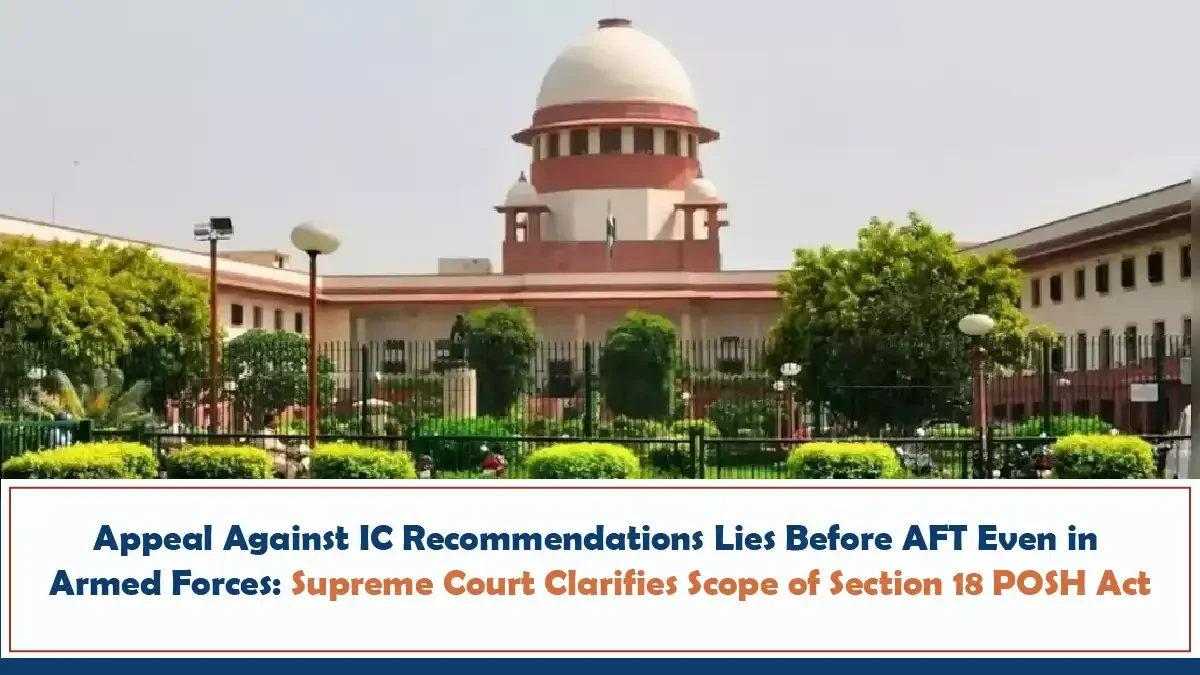
Before the Supreme Court, the principal issue was whether Section 18 of the POSH Act provides a statutory appellate remedy against ICC recommendations in a service context such as the Armed Forces, and whether the AFT erred in treating the matter as only a challenge to a show cause notice. The Court noted that Section 18 permits an appeal against specified ICC recommendations in accordance with applicable service rules, and that Section 14 of the Armed Forces Tribunal Act, 2007 enables the AFT to decide service matters.
Crucially, the Court held that the show cause notice could not be treated as a purely “preliminary” step insulated from scrutiny, because it was founded on the ICC report and recommendations, which themselves were under challenge. Therefore, the AFT ought to have examined the challenge to the ICC findings in accordance with law instead of declining to entertain the matter on the premise that only a show cause notice was involved. The Supreme Court also held that the High Court was incorrect in concluding that the appellant had no remedy under Section 18 of the POSH Act in the circumstances of the case.
Order
The Supreme Court set aside the orders of the AFT and the Delhi High Court and remanded the matter to the AFT for fresh adjudication of the appellant’s challenge to the ICC report and recommendations. The Court further directed that the show cause notice should not be acted upon pending consideration of the appeal before the AFT, and clarified that it expressed no opinion on the merits of the allegations.
Conclusion
The judgment clarifies that, in an Armed Forces service context, an aggrieved person may invoke Section 18 of the POSH Act to seek appellate scrutiny of ICC recommendations before the appropriate tribunal as per the applicable service law framework. Where a show cause notice is founded on ICC findings, it cannot be treated as merely preliminary so as to avoid examination of the underlying ICC report when that report is directly under challenge.
Written by Adv. K. Sri Hamsa