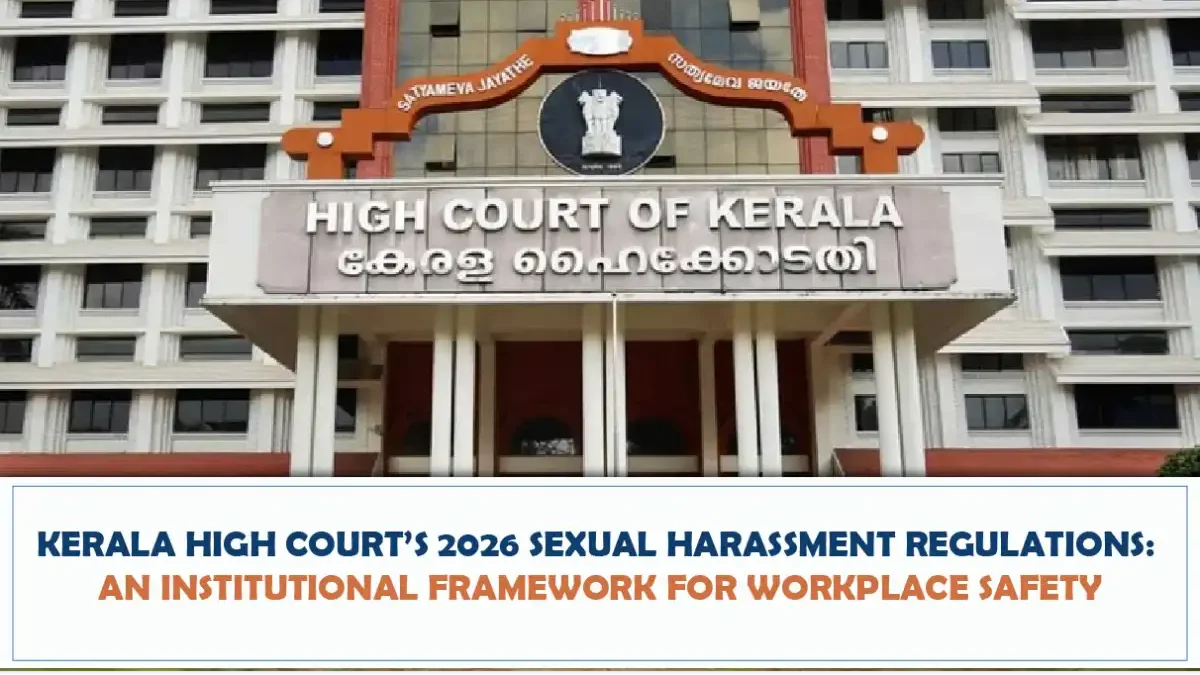
The notification of the Gender Sensitisation and Sexual Harassment of Women (Prevention, Prohibition and Redressal) Regulations, 2026 by the High Court of Kerala represents a structured step toward strengthening workplace safety within judicial institutions. The framework moves beyond procedural compliance and places responsibility on the institution to actively ensure a safe and dignified environment.
Constitutional and Jurisprudential Basis
The Regulations are grounded in Articles 14, 15, 19(1)(g), and 21 of the Constitution of India, which recognise equality, dignity, and the right to a safe working environment. They also draw from judicial precedents such as Vishaka v. State of Rajasthan and Medha Kotwal Lele v. Union of India, which emphasised the need for institutional mechanisms to address sexual harassment.
Scope and Applicability
The framework applies to women present within the High Court precincts, including advocates, litigants, interns, clerical staff, and visitors. The protection is not limited to formal employment relationships.
At the same time, certain categories are excluded. Women employees of the High Court and the Advocate General’s office are governed by separate Internal Committees under the Sexual Harassment of Women at Workplace (Prevention, Prohibition and Redressal) Act, 2013 and applicable service rules.
The jurisdiction is based on the physical premises of the High Court and extends to all areas under its control.
Definition of Sexual Harassment
The Regulations adopt a broad definition of sexual harassment. It includes physical contact, demands for sexual favours, sexually coloured remarks, sharing of explicit material, stalking, voyeurism, and any unwelcome conduct of a sexual nature. It also covers abuse of authority, implied or explicit promises or threats relating to employment, and the creation of a hostile work environment.
Institutional Mechanism
The Regulations establish the Gender Sensitisation and Internal Complaints Committee (GSICC), constituted by the Chief Justice. The Committee includes judges, advocates, external members, and women representatives, with a requirement that the majority of members are women.
The GSICC performs preventive functions such as awareness and sensitisation, and oversees the complaint process. It makes recommendations pursuant to inquiries conducted by an Internal Sub-Committee.
Complaint and Inquiry Process
A complaint is required to be filed within three months of the incident, with a provision for extension where justified. Upon receipt of a complaint, the GSICC constitutes an Internal Sub-Committee to conduct a fact-finding inquiry.
The inquiry includes recording statements and examining evidence and is to be completed within 90 days. The findings are submitted to the GSICC, which makes recommendations to the Chief Justice.
The Chief Justice considers the report and passes final orders after giving an opportunity of hearing to the parties. The authority to decide the outcome rests with the Chief Justice.
Powers and Procedural Safeguards
The GSICC and the Internal Sub-Committee are vested with powers similar to those of a civil court, including summoning individuals and requiring production of documents.
The Regulations provide for interim measures during the inquiry to safeguard the aggrieved woman, based on recommendations of the GSICC and subject to orders of the Chief Justice. Both parties are given an opportunity to present their case, ensuring procedural fairness.
Preventive Measures and Accountability
The GSICC is required to undertake regular awareness programmes, workshops, and policy dissemination. It must also submit annual reports detailing complaints received and action taken. These measures are intended to ensure ongoing compliance and institutional accountability.
Confidentiality
The framework includes confidentiality obligations to protect the identity of the parties and the integrity of the proceedings. This is intended to encourage reporting and prevent further harm.
Relationship with the POSH Act
The Regulations operate alongside the Sexual Harassment of Women at Workplace (Prevention, Prohibition and Redressal) Act, 2013. They provide a specialised mechanism for the High Court while maintaining consistency with the statutory framework.
Conclusion
The 2026 Regulations establish a structured mechanism for prevention and redressal of sexual harassment within the High Court of Kerala. By combining constitutional principles, judicial guidance, and institutional processes, the framework strengthens institutional accountability and reinforces a safe working environment within judicial spaces.
Written by Adv. K. Sri Hamsa