Case: XXX v. YYY (Bombay High Court, Goa Bench, 2026)
Factual Background
The case arose from a complaint of sexual harassment made by a female employee against the petitioner, who was a government servant working as a Lower Division Clerk. The complaint triggered proceedings before the Internal Complaints Committee (ICC) constituted under the POSH Act. Shortly thereafter, the complainant submitted a detailed retraction letter stating that the complaint had not been authored by her and that she had been coerced into signing a pre-prepared complaint. She specifically alleged that Respondent No. 3, the Principal of the institution, had threatened her and compelled her to file a false sexual harassment complaint against the petitioner. She further clarified that the petitioner had never engaged in any conduct amounting to harassment and that the allegations were entirely fabricated. The ICC, relying on the retraction, concluded that the complaint was false and malicious. However, instead of naming Respondent No. 3 as the instigator, the ICC recorded that the complaint had been filed at the behest of an “unknown source” and closed the proceedings. Aggrieved by this omission, the petitioner preferred an appeal before the Industrial Tribunal under Section 18 of the POSH Act, which was dismissed as not maintainable.
Court’s Analysis
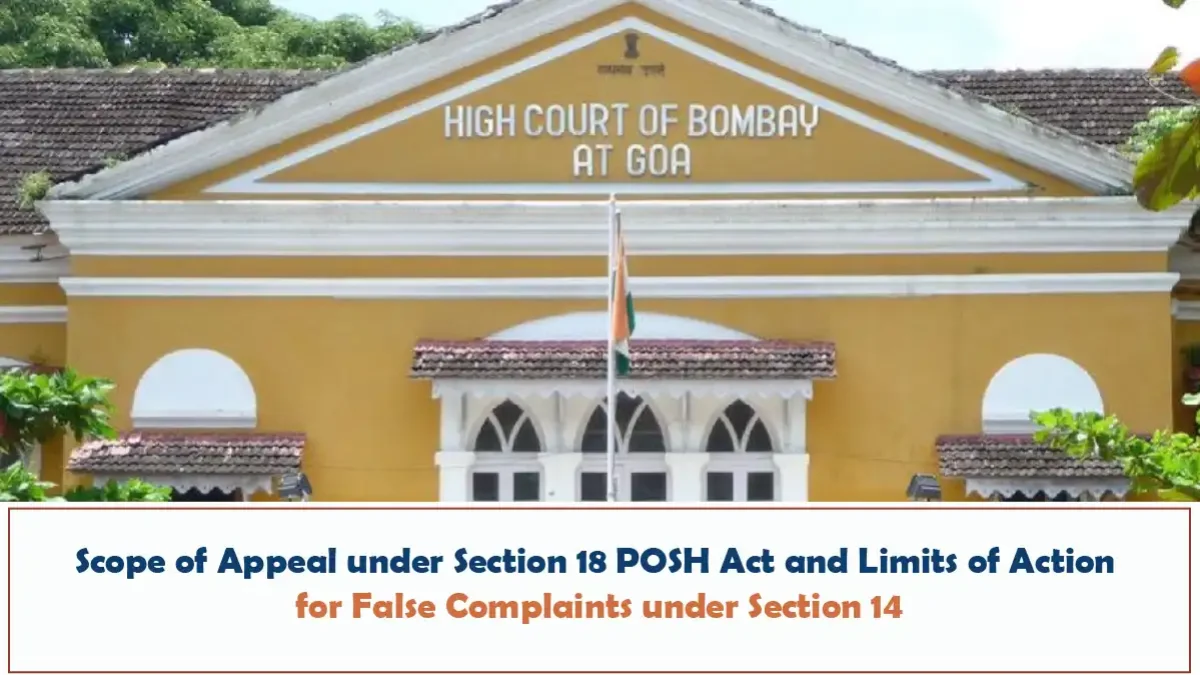
The High Court examined whether the appeal was maintainable and whether the ICC’s findings were legally sustainable. On maintainability, the Court held that the petitioner was a person aggrieved under Section 18 of the POSH Act and was entitled to file an appeal, even in the absence of direct injury. The Court rejected the Tribunal’s restrictive interpretation and emphasized that the statutory right of appeal must be construed broadly. On the merits, the Court found that the ICC had acted inconsistently by accepting the complainant’s retraction while failing to record the identity of the instigator, despite the complainant explicitly naming Respondent No. 3. The Court held that such selective reliance on the retraction was impermissible and that the ICC was obligated to consider the retraction in its entirety. Accordingly, the Court concluded that the ICC erred in describing the instigator as an “unknown source.” On the scope of Section 14 of the POSH Act, the Court held that the provision applies only to the complainant or the person making the complaint and does not extend to third-party instigators. Therefore, no action could be taken against Respondent No. 3 under Section 14 in the absence of a proper inquiry establishing malicious intent within the statutory framework.
Order of the Court
The High Court set aside the order of the Industrial Tribunal and modified the findings of the ICC by directing that the reference to an “unknown source” be replaced with a finding that Respondent No. 3 had instigated the complainant to file the false complaint. However, the Court declined to grant any relief in the nature of disciplinary action or punishment against Respondent No. 3 under Section 14 of the POSH Act.
Key Takeaway
The judgment clarifies that the right to appeal under Section 18 of the POSH Act is broad and extends to any person aggrieved by the findings of the ICC. It also emphasizes the duty of the ICC to maintain accuracy and consistency in its findings. Importantly, it delineates the limited scope of Section 14 of the POSH Act, making it clear that the provision does not cover third-party instigators of false complaints, thereby revealing a gap in the statutory framework.
Written by Adv. K. Sri Hamsa