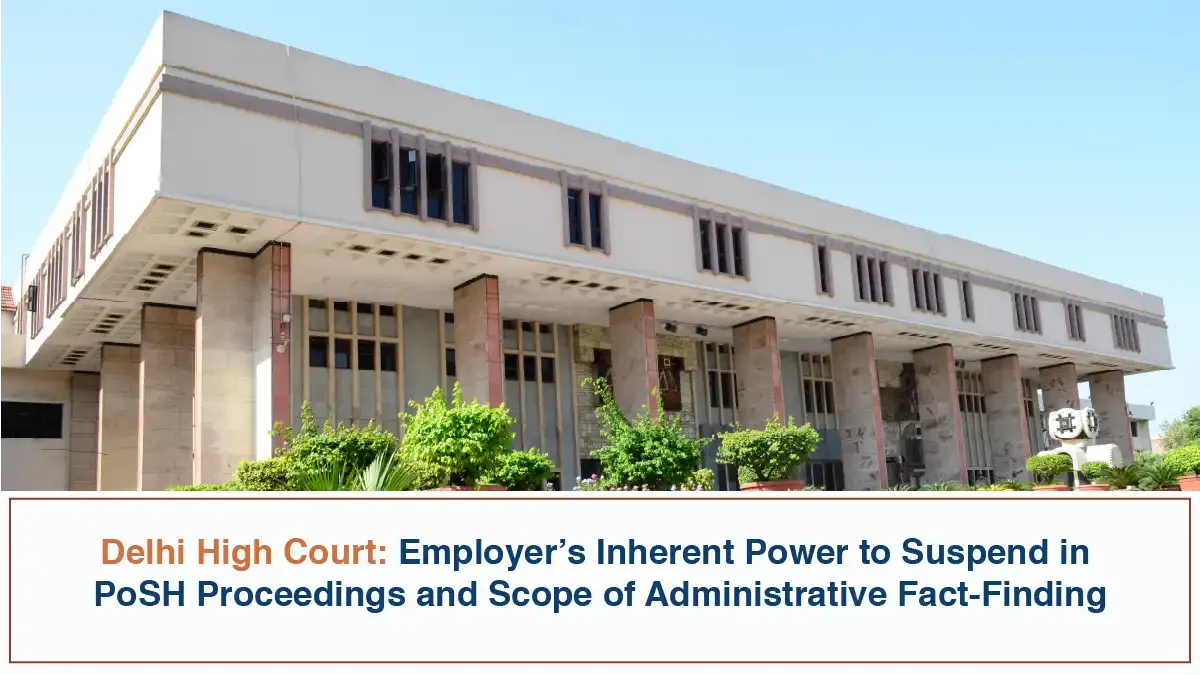
Case: Prof. Rasal Singh v. University of Delhi & Ors.
Factual Background
The petitioner, serving as the Principal of Ramanujan College, University of Delhi, filed the present writ petition challenging the constitution of an ad-hoc fact-finding committee, the report submitted by such committee, and the subsequent suspension order dated 18 September 2025 passed by the College. The impugned actions arose from multiple complaints of alleged sexual harassment made by faculty members under the Sexual Harassment of Women at Workplace (Prevention, Prohibition and Redressal) Act, 2013.
Upon receipt of the complaints, the Deputy Registrar (Colleges), University of Delhi constituted a fact-finding committee to examine the allegations. The committee conducted proceedings and submitted a report concluding that the allegations were serious in nature and could potentially constitute sexual harassment under the PoSH Act. It also recorded that the complainants felt intimidated and unsafe due to the petitioner’s position of authority.
Based on this report, and with the approval of the Vice-Chancellor, the College passed an order suspending the petitioner. The petitioner challenged these actions, contending that the PoSH Act mandates that such complaints be examined only by the Internal Complaints Committee (IC), and that the suspension was illegal and stigmatic.
Court’s Analysis
The Court examined three primary issues: whether the College had the authority to suspend the petitioner in a PoSH-related matter; whether the Deputy Registrar could constitute an ad hoc fact-finding committee; and whether the suspension order was stigmatic.
On the issue of suspension, the Court reiterated the settled principle of service law that an employer possesses an inherent power to suspend an employee pending inquiry into allegations of misconduct. This power flows from the employer-employee relationship and exists independently of any specific statutory provision. The Court held that such suspension is an interim administrative measure intended to facilitate a fair and impartial inquiry.
The Court further analysed the relationship between the PoSH Act and service law. It noted that Section 28 of the PoSH Act provides that the Act is “in addition to” and “not in derogation of” other laws. Accordingly, the PoSH Act does not override or restrict the disciplinary powers of an employer. Instead, it operates alongside existing service rules, which continue to govern actions such as suspension.
With respect to the constitution of the fact-finding committee, the Court rejected the petitioner’s contention that only the IC could examine such matters. It held that an employer is not precluded from constituting a preliminary fact-finding body to assess the situation and take appropriate interim measures. Such a committee does not substitute the role of the IC but merely assists in administrative decision-making.
On the question of stigma, the Court drew a distinction between suspension as a penalty and suspension pending inquiry. It held that suspension at the preliminary stage, without any finding of guilt, does not amount to a punitive or stigmatic action.
Order of the Court
The Court upheld the validity of the suspension order as well as the constitution of the ad hoc fact-finding committee and dismissed the petition.
Key Takeaway
The judgment affirms that the PoSH Act operates alongside existing service law frameworks and does not curtail the employer’s inherent disciplinary powers. Employers retain the authority to suspend employees pending inquiry and may constitute preliminary fact-finding bodies without encroaching upon the statutory role of the Internal Complaints Committee. Suspension pending inquiry is an administrative measure and does not, by itself, carry stigma.
Written by Adv. K. Sri Hamsa