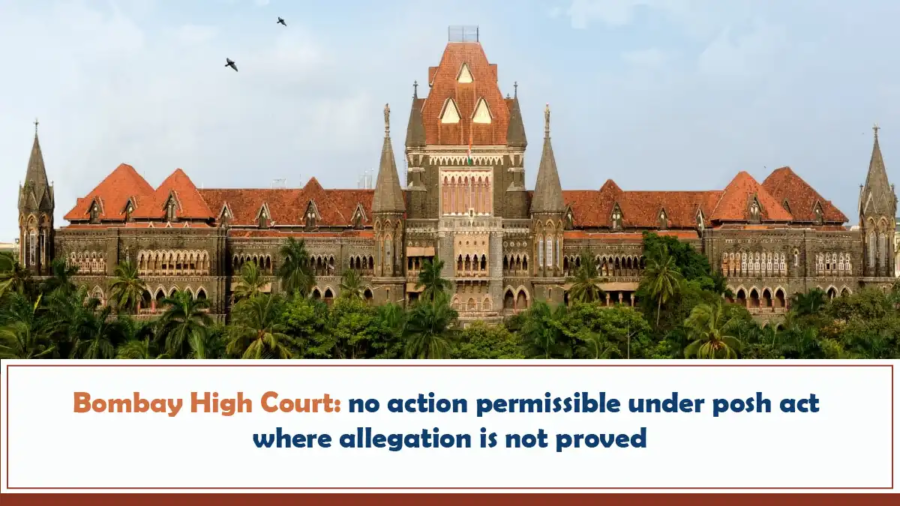
Bombay High Court: No Action Permissible Under POSH Act Where Allegation Is Not Proved
Petition
The Bombay High Court examined the scope and limits of powers exercised by a Complaints Committee constituted under the Sexual Harassment of Women at Workplace (Prevention, Prohibition and Redressal) Act, 2013 (“POSH Act”). While the body was referred to as a Complaints Committee (CC) in the present case, it is generally referred to as the Internal Committee (IC) under the POSH Act.
The challenge arose from disciplinary action imposed on an employee following an inquiry conducted under the POSH framework. Although the Committee recorded a finding that the conduct complained of did not constitute sexual harassment within the meaning of the Act, it nevertheless recommended that disciplinary action be initiated. Acting on this recommendation, the employer imposed a penalty.
The employee approached the High Court contending that such action was contrary to the express provisions of the POSH Act.
Contentions
It was contended that Section 13(2) of the POSH Act mandates that where the Complaints Committee / Internal Committee concludes that the allegation of sexual harassment has not been proved, it must recommend that no action be taken against the respondent.
The petitioner argued that once the Committee had categorically held that the act of videographing colleagues did not amount to sexual harassment under the POSH Act, the Committee lacked jurisdiction to recommend any disciplinary measures under service rules.
On behalf of the employer, it was argued that the conduct was inappropriate and disruptive to workplace discipline and that the Committee’s recommendation was sufficient to justify disciplinary action, notwithstanding the finding that the conduct did not amount to sexual harassment.
Conclusion
The Bombay High Court held that the statutory framework of the POSH Act does not permit a Complaints Committee / Internal Committee to recommend disciplinary action once it concludes that the allegation of sexual harassment is not proved.
The Court observed that the jurisdiction of the Committee is confined strictly to determining whether the conduct complained of falls within the definition of sexual harassment under the Act. Upon recording a negative finding, the Committee is bound by Section 13(2) to recommend closure of the complaint with no action against the respondent.
It was further held that any disciplinary action imposed solely on the basis of such a recommendation, without an independent inquiry, is unsustainable in law. The Court accordingly set aside the penalty, reiterating that penal consequences cannot flow from a POSH inquiry where the foundational allegation is unsubstantiated.
Written by Adv. Aiswarya Krishnan