

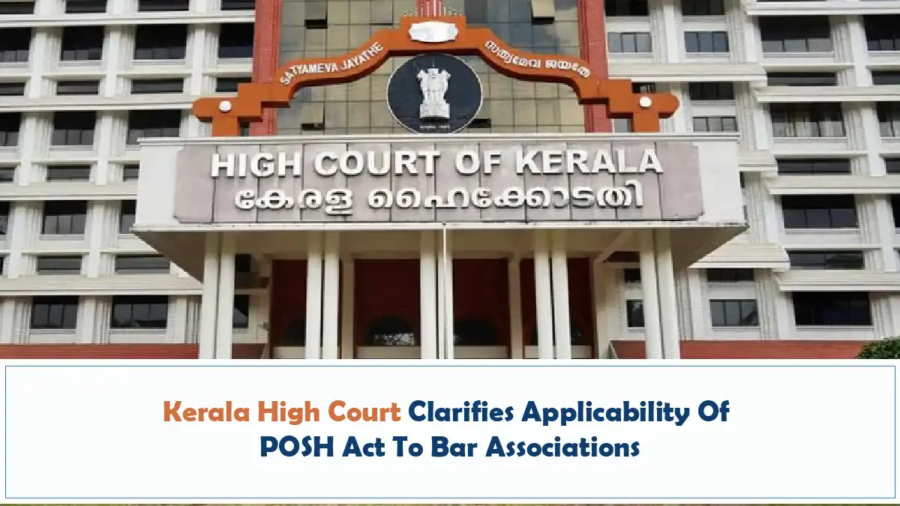
Kerala High Court Clarifies Applicability Of POSH Act To Bar Associations
Advs. Sri.S.Sreekumar and Ors. V. The Kollam Bar Association and Ors., WP(C) No. 39539 of 2024
The Kerala High Court has examined the scope and applicability of the Sexual Harassment of Women at Workplace (Prevention, Prohibition and Redressal) Act, 2013 (“POSH Act”) in the context of Bar Associations and has clarified that a Bar Association does not qualify as an “employer” under the Act. The ruling arose from a challenge to proceedings initiated by the Kollam Bar Association through an Internal Complaints Committee (ICC) constituted by it purportedly under the POSH framework.
The case originated from a complaint made by a junior advocate against a senior advocate, following which the Bar Association constituted an ICC and conducted an inquiry. Based on the findings of the ICC, disciplinary action was initiated against the respondent advocate. The said action was challenged before the High Court on the ground that the Bar Association lacked the statutory authority to constitute an ICC under the POSH Act, as it does not stand in an employer–employee relationship with its members.
Legal Issues
The principal issue before the Court was whether a Bar Association can be treated as an “employer” within the meaning of Section 2(g) read with Section 2(k) of the POSH Act, thereby enabling it to constitute an Internal Complaints Committee under Section 4 of the Act. The Court was also required to consider whether proceedings undertaken by such an ICC, constituted without statutory backing, could be sustained in law.
In its analysis, the High Court emphasised that the obligation to constitute an Internal Complaints Committee under the POSH Act is specifically cast upon an employer in relation to a workplace where an employer–employee relationship exists. The Court observed that Bar Associations are voluntary professional bodies formed for the welfare and collective representation of advocates and do not exercise administrative control or supervision over their members in the manner contemplated under the statute. Mere membership of an advocate in a Bar Association, the Court held, does not create an employer–employee relationship for the purposes of the POSH Act.
The Court further held that allowing Bar Associations to constitute ICCs under the POSH Act would amount to expanding the statutory framework beyond its legislative intent. Consequently, the ICC constituted by the Kollam Bar Association and the inquiry conducted by it were held to be contrary to the provisions of the POSH Act and were accordingly set aside. However, the Court clarified that this would not preclude the complainant from seeking redressal through other legally permissible mechanisms, including disciplinary proceedings under the Advocates Act, 1961 or the relevant Bar Council rules.
Conclusion
This decision provides important clarity on the institutional limits of the POSH Act and reiterates that compliance obligations under the statute are intrinsically linked to the existence of an employer–employee relationship. While the judgment restricts the ability of Bar Associations to invoke POSH mechanisms, it also underscores the need for appropriate alternative grievance redressal frameworks within professional bodies. Organisations and associations must carefully assess whether they fall within the statutory definition of “employer” before constituting ICCs, as proceedings undertaken without jurisdiction may be rendered legally unsustainable despite the gravity of the allegations involved.
Written by Adv. Aiswarya Krishnan