

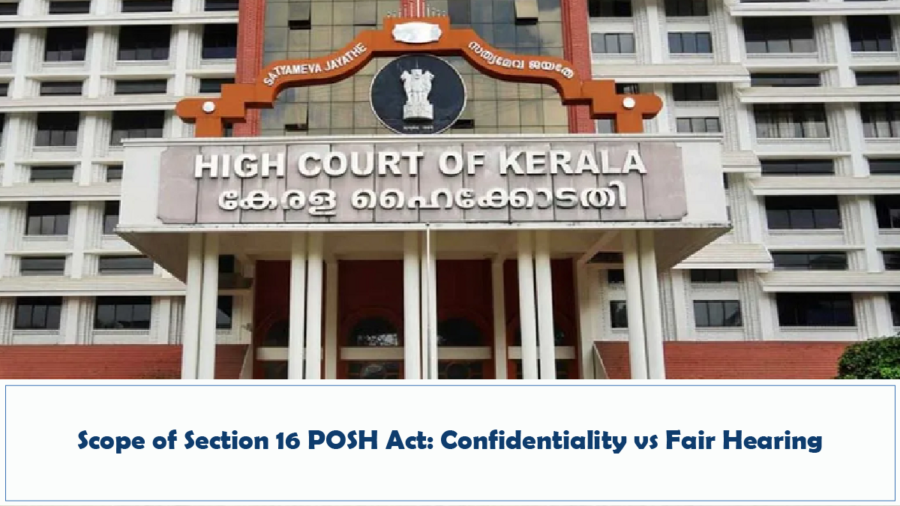
Scope of Section 16 POSH Act: Confidentiality vs Fair Hearing
Case: Linson K. Thomas v. Union of India & Ors. (Kerala High Court, 2026)
Factual Background
The petitioner, an employee of the Food Corporation of India, challenged transfer orders issued during the pendency of disciplinary proceedings arising out of allegations of sexual harassment at the workplace. The petitioner contended that the transfer was punitive in nature and intended to victimize him. He further alleged that the disciplinary proceedings were conducted in violation of principles of natural justice, as he was denied access to relevant documents and materials necessary to defend himself. Additionally, the petitioner challenged the withdrawal of his status as a ‘protected workman,’ asserting that the same was arbitrary and unjustified.
Court’s Analysis
The Court examined the scope of Section 16 of the POSH Act and clarified that the provision restricts publication of proceedings to the public, but does not prohibit furnishing relevant documents to the delinquent employee for the purpose of defence. It emphasized that disciplinary proceedings arising from POSH complaints must adhere to principles of natural justice, including the right to receive documents and effectively defend oneself. At the same time, the Court reiterated that transfer is an incidence of service and interference is warranted only when the action is shown to be mala fide or punitive. The Court also found that withdrawal of protected workman status was justified in light of pending disciplinary proceedings.
Order of the Court
The Court rejected the challenge to the transfer orders and the withdrawal of protected workman status. However, it directed the respondents to furnish all relevant documents relied upon in the disciplinary proceedings to the petitioner and to provide him with adequate opportunity, including assistance for defence, to contest the charges.
Key Takeaway
The judgment clarifies that confidentiality under the POSH Act cannot be used to deny a fair opportunity of defence. It reinforces the principle that natural justice must be upheld in disciplinary proceedings, while also affirming that administrative transfers will not be interfered with unless clearly punitive or mala fide.
Written by Adv. K. Sri Hamsa