

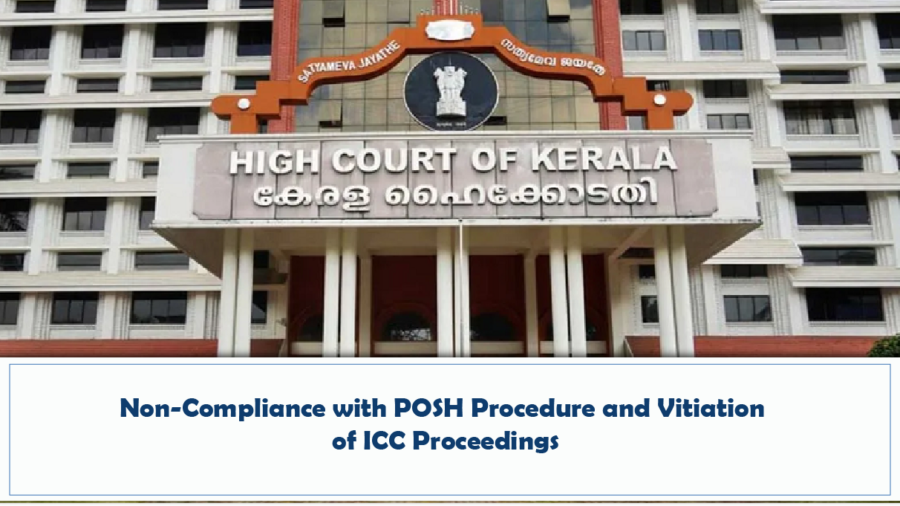
Non-Compliance with POSH Procedure and Vitiation of ICC Proceedings
Case: X v. Kerala Social Security Mission & Ors. (Kerala High Court, 2026)
Factual Background
The present writ petition was filed challenging the termination of the first petitioner and adverse findings against the second petitioner arising out of an inquiry conducted by the Internal Complaints Committee (ICC) under the Sexual Harassment of Women at Workplace (Prevention, Prohibition and Redressal) Act, 2013. The petitioners contended that the ICC proceedings were fundamentally flawed and violative of statutory requirements. Specifically, it was alleged that they were not furnished with a copy of the complaint at the initial stage, were denied access to relevant documents, and were not given an effective opportunity to cross-examine the complainant or witnesses. The petitioners further submitted that they were summoned to participate in the inquiry without being made aware of the precise allegations, thereby depriving them of a meaningful opportunity to defend themselves.
Court’s Analysis
The Court undertook a detailed examination of Section 11 of the POSH Act and Rule 7 of the POSH Rules, which govern the procedure for inquiry by the Internal Complaints Committee. It held that the inquiry must be conducted in a manner akin to a disciplinary proceeding, ensuring compliance with the principles of natural justice. The Court emphasized that Rule 7(2) mandates that a copy of the complaint must be furnished to the respondent within a stipulated time, enabling the respondent to prepare a defence. Further, Rule 7(3) and (4) require that the respondent be given an opportunity to file a reply, present evidence, and effectively participate in the inquiry.
The Court clarified that denial of such procedural safeguards strikes at the root of fairness and renders the inquiry legally unsustainable. It also relied on judicial precedents, including the Supreme Court’s observations in Aureliano Fernandes v. State of Goa, to reiterate that even in sensitive proceedings under the POSH framework, adherence to natural justice is non-negotiable. The Court rejected the contention that mere awareness of allegations or partial disclosure would suffice, holding that full disclosure of relevant materials is essential to ensure a fair adjudicatory process.
On facts, the Court found that the petitioners were not provided with copies of the complaint or supporting materials in a timely manner, and were denied the opportunity to cross-examine witnesses or present their own evidence. These lapses were held to constitute a clear violation of statutory provisions as well as the audi alteram partem rule.
Order of the Court
In light of the procedural irregularities and violations of natural justice, the Court set aside the report of the Internal Complaints Committee. It directed the competent authority to conduct a fresh inquiry in accordance with the provisions of the POSH Act and Rules, ensuring that all procedural safeguards are strictly complied with. A time-bound direction was issued for completion of the inquiry, while clarifying that the Court had not expressed any opinion on the merits of the allegations.
Key Takeaway
The judgment firmly establishes that proceedings under the POSH Act, though intended to protect victims of workplace harassment, must equally safeguard the rights of the respondent by adhering to principles of natural justice. Non-supply of the complaint, denial of opportunity to cross-examine witnesses, and lack of fair hearing constitute fatal defects that vitiate the entire inquiry. The decision serves as a strong precedent reinforcing procedural fairness in ICC proceedings.
Written by Adv. K. Sri Hamsa