

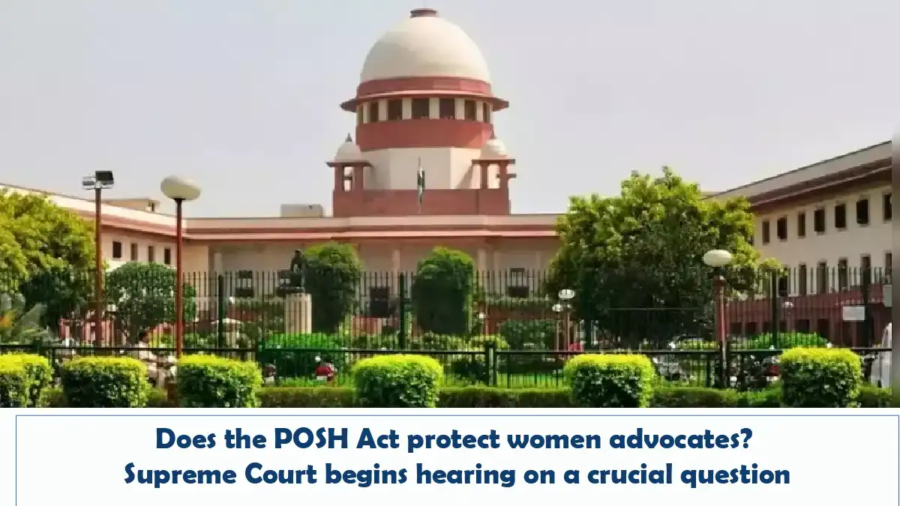
Does the POSH Act protect women advocates? Supreme Court begins hearing on a crucial question
On 21 November 2025, a bench of the Supreme Court of India comprising Justices BV Nagarathna and R. Mahadevan issued notice to the Union of India and the Bar Council of India in a petition questioning whether women advocates are entitled to the protections of the Sexual Harassment of Women at Workplace (Prevention, Prohibition and Redressal) Act, 2013 (Hereinafter referred to as “POSH Act”). The petition, titled Seema Joshi v. Bar Council of India and Others, challenges a recent ruling that excludes women advocates from the statute’s ambit.
The development comes after a July 2025 judgment of the Bombay High Court in UNS Women Legal Association (Regd.) v. Bar Council of India and Others. The High Court held that the POSH Act does not apply to advocates because there is no employer–employee relationship between them and Bar Councils. As a result, Bar Councils were found to have no obligation to constitute Internal Committees for handling sexual harassment complaints by women lawyers.
Why the petitioners argue the exclusion is flawed
The petition, which has support from the Supreme Court Women Lawyers Association, contends that the High Court’s interpretation defeats the very purpose of the POSH Act. According to the petitioners, the Act was designed as a social welfare legislation to secure the right of every woman to a safe working environment. They argue that limiting its protections to employees would leave a vast number of women who work independently, including advocates, without any statutory redressal mechanism.
The petition stresses that women advocates are active participants in courts, Bar Council offices, legal chambers and other institutional spaces which function as their workplaces in every practical sense. Therefore, they require the same protections that women in corporate, academic or service settings receive.
The petitioners further argue that the Advocates Act, 1961 does not provide safeguards equivalent to the confidentiality, defined procedures and victim-centric remedies incorporated in the POSH framework. They also rely on the Supreme Court’s earlier directions in Medha Kotwal Lele v. Union of India, which recognised the need for grievance mechanisms for women operating in legal institutions long before the POSH Act came into force.
What the Bombay High Court decided and why it is being revisited
The Bombay High Court’s ruling focused solely on the existence of an employer–employee relationship. Since advocates are self-employed professionals and not employees of the Bar Councils, the Court held that the POSH Act cannot govern complaints arising within the legal profession.
This reasoning has come under scrutiny. The petitioners point out that the POSH Act defines both “workplace” and “aggrieved woman” broadly, without tying them exclusively to employment. They argue that the judgment imposes a narrow interpretation that is neither supported by the statutory language nor by the intent behind the legislation.
Why the case matters beyond the legal profession
This litigation raises an important national question. India’s workforce increasingly includes independent professionals, consultants and freelancers who do not have a formal employer. Whether they are advocates, journalists, designers or artists, many women today work in spaces that resemble workplaces but fall outside labour-law structures.
A progressive interpretation by the Supreme Court could affirm that the right to safety and dignity at work cannot be limited by the nature of one’s contract or employment status. It would also restore confidence that statutory protections evolve with changing modes of work.
Looking ahead
The matter has been tagged with similar petitions raising concerns about the absence of gender-sensitive mechanisms in legal institutions. Replies from the Union of India and the Bar Council of India will likely shape the next hearing.
For now, the legal community is watching closely. The Supreme Court’s decision has the potential to close a long-criticised gap in the law, or it may reaffirm a restrictive interpretation that leaves women advocates without the full protection of a landmark gender-justice statute.
Written by Adv. Aiswarya Krishnan