

After the end of a long week, I sat down to unwind, went to the most watched section of Netflix and turned on the first show on the list, Adolescence. By the end of episode 2, I felt an eerie sense of familiarity with the language the characters used, including the emojis on social media. That, for me, was the beginning of going down the rabbit hole of the manosphere and incel culture. Adolescence threw a spotlight on how manosphere content can draw in young boys through feelings of loneliness, insecurity and the search for belonging. Rather than presenting radicalization as sudden, the series shows how seemingly harmless online content can gradually normalize misogyny, resentment and distorted ideas about masculinity and relationship.
For many young people, especially men, the search for answers to questions like: ‘Why I am single?’, ‘Why do I feel invisible?’, etc. seems to on YouTube, Reddit, discord, podcasts, or other social media platforms filled with ‘advice’ on dating and self-improvement. This pulls them into interconnected communities, which in this case, ultimately pulls them into an ideological space called the manosphere.
This article tries to unfold the manosphere and understand how these spaces came to be, what discourses these spaces have, and what impact these spaces ultimately may have.
What is the ‘Manosphere’?
The Manosphere is not a singular social media platform or organization, but a loose network of different forms and types of social media platforms, including online communities, influencers, forums, and podcasts, which are made up of ‘anti-feminist groups to defend men’s rights and promote heteronormative, sexist, misogynistic, patriarchal, and racist belief systems.’[1]
Though the content revolves around fitness, financial independence, or men’s mental health, it often finds answers in misogynistic narratives, conspiracy theories about gender relationships and portrays women as manipulative and society as biased against men. Out of the audience that engages in such content, while not all engage in content that has extremist views, the boundaries between self-help and radical ideology are often blurred.
Based on Ribeiro’s research in 2021 and Solea and Sugiura’s in 2023, the Manosphere can be divided into various sub-cultures. One is ‘Men Going Their Own Way (MGTOW), which believes that feminism has corrupted society and propagates the idea of avoiding relationships with women. Men’s Rights Activists (MRAs) is another that believes that men have become powerless, ignored and oppressed. Another sub-culture is the Pick Up Artists (PUAs), which promotes harassment and using seduction techniques to make men more desirable to women whom they objectify. There is also the Involuntary Celibates (incels) group that is most associated with violence and argues that sex is a basic human right, which is denied to men due to the feminist movement and female empowerment.’[2]
It is also important to note that further research, including research by Ging in 2019, shows that the Manosphere is much more complex than being divided into the above-mentioned categories, including Traditional Conservatives (TradCons)[3], Gamer/geek, the father’s rights movement, NoFappers, and chauvinist far-right groups[4].
Similar to subcultures, there are also different forms of ideologies that exist within the Manosphere. This includes the blackpill ideology, red pill ideology, blue pill ideology and white pill ideology.
What is a Black, Red, Blue and White Pill?
The blackpill ideology heavily relies on evolutionary psychology and biological determinism[5]. In summary, they believe that physical appearance and genetics permanently determine romantic success and leave some men with little or no hope of meaningful relationships. This, contrary to giving them answers about their search to find romantic partners, encourages hopelessness, and many individuals express this online by glorifying hate and misogyny while some others engage in and celebrate acts of gender-based violence.
The phrase ‘red pill’ and ‘blue pill’ comes from the 1999 movie ‘The Matrix’.
Red pill symbolizes awakening to hidden truths. This, in the Manosphere, means uncovering the dynamics of dating and society, which, according to them, is that women are hypergamous, feminism disadvantages men and that traditional social norms are overturned to the detriment of men.
While blue pill allows one to remain or return to the false world. This, in the Manosphere, would mean denial of the ‘truth’.
Lastly, the white pill represents an effort to improve one’s life, accepting the incel status.
Who are ‘Incels’?
Ironically, ‘incel’ originates from a blog created by Alana in the 1990s called ‘Alana’s Involuntary Celibacy Project’[6], which intended to provide an inclusive space for individuals (all gender identities) experiencing romantic and social exclusion. However, at the start of the 2000s, it evolved into a space dominated by men propagating a misogynistic ideology[7], i.e., a system of beliefs that portrays women as inherently inferior to men and less deserving of rights and to be controlled and subordinated because of their gender.
“@9:20 is so real. I’m curious as to what this lady would rate herself. She herself is not above a 3 and she’s oblivious to it”
– A comment on a YouTube channel called Fresh & Fit
The first Incel subreddit, /r/ForeverAlone, dates back to the late 2010s.[8] But the community grew in 2016 and was banned in November 2017[9]. Despite this, it continued to grow and became most active in early 2018. Over time, they even developed their own language that supported their beliefs and worldview and ensured that their ideological framework was reinforced within the community. This included terms that dehumanize women by turning them into subhumans or the ‘other’ and referring to them as animals, food, inanimate objects and humanoids[10].
They portray themselves as logical and rational, keeping the red pill ideology central to their worldview while also relying on ‘pseudo-scientific’ discussions based on the blackpill ideology. This is because while these studies that they rely on maybe scientifically valid, their selective interpretation[11] of the same creates a harmful framework of discussion in these heavily discriminatory spaces. One such example is drawing from evolutionary psychology:[12] “We are, indeed, no longer in hunter-gatherer times. However, much of what was at play then still applies today. This includes women of course desiring bigger and more physically intimidating men, among many other things. It’s all evolutionary behavior bro.”
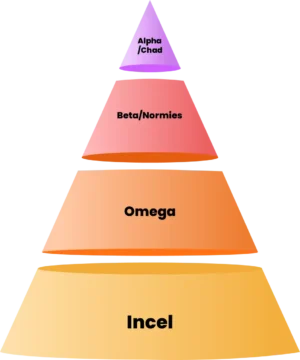
Further, within this worldview, there also exists a hierarchy of men and women. The hierarchy of men begins with the alpha/Chad, who is considered an extremely attractive and sexually successful man with high social status and a victim of social conditions which allow women to exploit him financially and emotionally.
Then are the beta/normies, which refers to a ‘weak’ man with an average appearance who relies on trading money, power or emotional intimacy for sex.
Then is the omega, a socially isolated man with low confidence. Lastly, there is the incel, a man involuntarily excluded from dating due to appearance, genetics or social hierarchy.
The hierarchy for women begins with the Stacy on top, the attractive woman who does not provide sexual access and benefits from her social status and is shallow and manipulative. This is followed by Becky, a woman with average appearance who has unrealistic standards and would want to date men more attractive than her. Thus, this worldview reduces human relationships to transactional narratives, also calling it an 80/20 rule, i.e., ‘80 % of women have sex and are monopolised as romantic partners by the 20 % of men at the top of the hierarchy.’[13]
This is not only limited to the use of language, but also to the use of other forms of expression on social media, including emojis. One such example was also shown in the series Adolescence, where a kidney bean (🫘) is used to refer to someone as an ‘incel’. The male protagonist of the series also goes on to talk about the meanings of a heart with different colours, i.e., red being love (❤️), purple being sexual interest (💜), yellow being curiosity or interest (💛), pink being non-sexual interest (🩷) and orange being reassurance or support (🧡).
Adolescence also makes it evident that that it is not only to older men, but that the influence of this increasingly extends to teenage boys and even younger adolescents. Many are drawn into videos and online communities centred on self-improvement, fitness, gaming or dating advice. As they spend time in these digital spaces, algorithms and peer networks gradually expose them to more patriarchal and misogynistic narratives framing women as their enemy. This is then reflected around the content they consume, like the below comment on a YouTube video on the channel called JustPearlyThings.

Where does Manosphere lead to?
The article began with questions that men wanted answers to about their masculinity, relationships, the feeling of being invisible and how the search for these answers starts with these social media platforms, which pull them into the manosphere. The question then is: is this space giving them the answers they need?
Research shows it doesn’t. While studying the behaviour of men part of the manosphere, specifically incel culture, researchers observed patterns of depression, anxiety and social isolation[14], which further led them to seek validation from the online community. They reported feeling lonelier and having less social support[15] than those who were not part of this space.
This pushed them into unhealthy coping mechanisms and created a vicious loop of loneliness and isolation. Researchers also found violence, including acts of rape, being used as a tool for seeking attention, revenge, reinforcing masculinity and generating political change[16], which was further glorified by others, including fantasizing such acts. This included ‘jokes’[17] around suicide in the name of dark humour.
Broyd, in their research in 2023, also noted that a sub‐group of the incel community called themselves ‘mentalcels’, attributing their Inceldom to mental illness or neurodivergence[18]. He also highlighted how the origin of why these men dived into this space in turn created a space for them, which made them even more vulnerable than they were. In his words, ‘Incels have a negative view of themselves, the world, and their future—to explain the high prevalence of hopelessness in Incel thought processes. This combines with the ‘triad of risk’—(a) fixation on a lack of sexual experience, (b) cognitive distortions, and (c) blaming women for their frustrations—which demonstrates the connection between Incel’s mental ill health and the risks they pose, since they may escalate to violence if they feel misunderstood by society, and view harming themselves and/or others as their only option.’[19]
Conclusion
Through this article, we explored the origins of the manosphere and an incel sub-culture. This provided us a window to the worldview that exists within these communities and how the same could be harmful to people within and also outside of these communities. This shows that it is no longer a virtual conversation or discourse.
The internet is a space of transformation where people seek advice, build communities and understand themselves, but the manosphere is evidence of both an opportunity and a danger of that transformation. The manosphere has a vast reach due to the popularization of its content, which increases the risk of people, especially young adults, getting pulled into it due to the lack of media literacy.
Thus, for children, parents, educators and policymakers, the question is no longer whether these communities exist, but how society can foster an environment where people, especially young men, find support without being pulled into a space of resentment, misinformation and further loneliness.
Thus, it is important to understand the manosphere and incel culture to recognize the social conditions that allow such spaces to grow and ensure the search for answers is towards empathy and belonging and not division and hate.
Written by Adv. Lakshita Bhati, Reviewed by Adv. Shambhavi Rai and Rosanna Rodrigues.
Sources:
[1] Rodriguez, R., Maldondao. M, Moyano M. (2025). “Deciphering the incels: A scoping review on empirical research”. Aggression and Violent Behavior,
2. Deciphering the incels: A scoping review on empirical research – ScienceDirect
[2] Id at 2.
[3] Ging, D. (2019). Alphas, betas, and Incels: Theorizing the masculinities of the Manosphere. Men and Masculinities, 22(4), 638–657.
[4] Perliger, A., Stevens, C., & Leidig, E. (2023). Mapping the ideological landscape of extreme misogyny. ICCT / Asser Institute.
[5] Ibid 1 at 2-3.
[6] Fowler, K., Green, R., & Palombi, A. (2023). From Stacys to Foids, a discursive analysis of the Incel’s gendered Spectrum of political agency. Deviant Behavior, 1-17. https://doi.org/10.1080/01639625.2023.2233668.
[7] Gheorghe, R. M., & Yuzva Clement, D. (2023). “It’s time to put the copes down and get to work”: A qualitative study of incel exit strategies on r/IncelExit. Behavioral Sciences of Terrorism and Political Aggression, 1–21. .
[8] Ribeiro, H.M. et al. “The Evolution of the Manosphere Across the Web.” The Fifteenth International AAAI Conference on Web and Social Media. Volume 15, 5. https://doi.org/10.48550/arXiv.2001.07600
[9] Solon, O. 2017. “Incel”: Reddit bans misogynist men’s group blaming women for their celibacy. ‘Incel’: Reddit bans misogynist men’s group blaming women for their celibacy | Reddit | The Guardian
[10] Ibid 1 at 8.
[11] Ibid 1 at 3.
[12] Vallerga, M., Zurbriggen, L. E. “Hegemonic masculinities in the ‘Manosphere’: A thematic analysis of beliefs about men and women on The Red Pill and Incel.” Analyses of Social Issues and Public Policy, Wiley. 610. doi: 10.1111/asap.12308
[13] Menzie, L. (2022). Stacys, Beckys, and chads: the construction of femininity and hegemonic masculinity within incel rhetoric. Psychology & Sexuality, 13(1), 69–85. https://doi.org/10.1080/19419899.2020.1806915
[14] Ibid 1 at 9.
[15] Ibid at 9.
[16] O’Donnell, C., & Shor, E. (2022). “This is a political movement, friend”: Why “incels” support violence. The British Journal of Sociology, 73(2), 336–351. https://doi.org/10.1111/1468-4446.12923
[17] Ibid 12 at 617.
[18] Broyd, J., L. Boniface, D. Parsons, D. Murphy, and J. D. Hafferty. 2023. “Incels, Violence and Mental Disorder: A Narrative Review With Recommendations for Best Practice in Risk Assessment and Clinical Intervention.” BJPsych Advances 29, no. 4: 254–264. Incels, violence and mental disorder: a narrative review with recommendations for best practice in risk assessment and clinical intervention | BJPsych Advances | Cambridge Core
[19] Id at 4.