

HomeBlogPOSHAct & RulesSexual Harassment of Women at Workplace Act & Rules: The Evolution
Sexual Harassment of Women at Workplace Act & Rules: The Evolution
Sexual harassment at the workplace is a serious impediment to women’s right to a safe workplace and can significantly undermine their ability to work with dignity, safety and equality. More than a decade after the enactment of the POSH Act, workplace sexual harassment continues to remain an active concern across the country, with 985 cases reported in FY 2024-25. The consequences of sexual harassment can extend well beyond the particular act or interaction involved. It can create an environment of discomfort, humiliation or fear, affect an individual’s wellbeing and professional experience, and undermine the conditions necessary for a safe and respectful workplace.
In India, this protection is principally governed by the Sexual Harassment of Women at Workplace (Prevention, Prohibition and Redressal) Act, 2013 (POSH Act), which came into force on 9 December 2013, along with the Sexual Harassment of Women at Workplace (Prevention, Prohibition and Redressal) Rules, 2013 (POSH Rules), as notified by the Ministry of Women and Child Development.
For a copy of the Act, click here, and for a copy of the Rules, click here.
This comprehensive guide takes a detailed look at the POSH framework, from the origins and scope of the law to complaint mechanisms, employer obligations, emerging compliance requirements and recent judicial developments that continue to shape its implementation in practice.
Evolution of the POSH Act
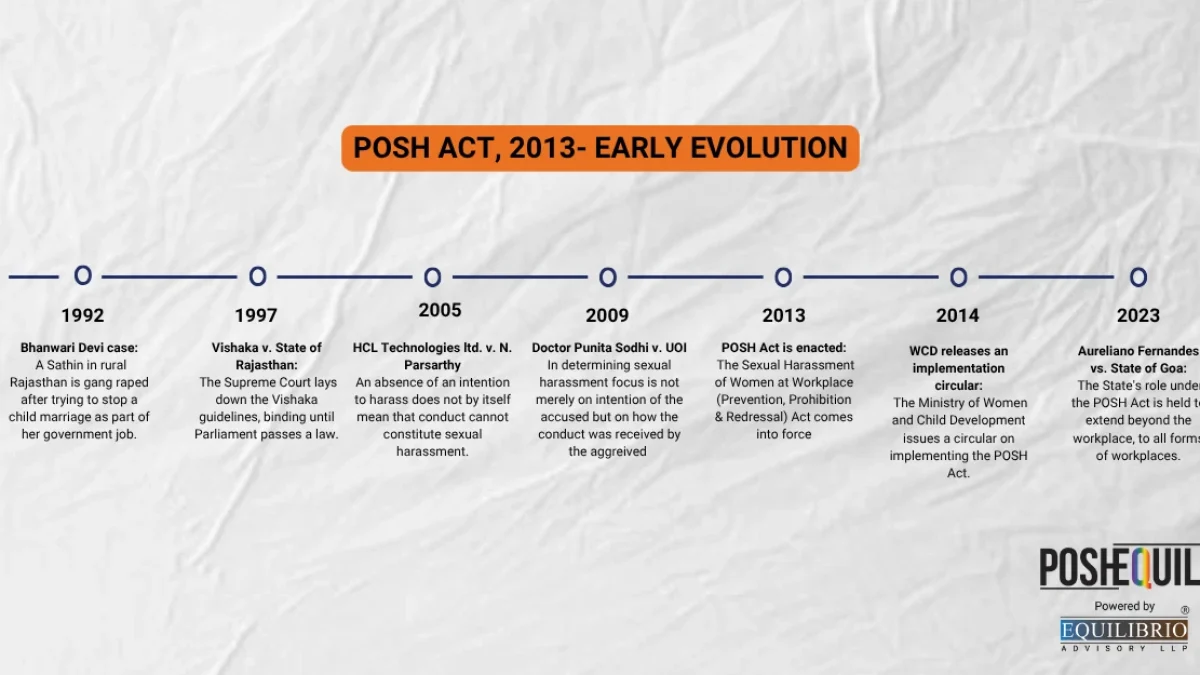
The origins of India’s workplace sexual harassment law can be traced back to the Supreme Court’s landmark decision in Vishaka and Ors. Vs. State of Rajasthan (1997). This case arose against the background of the brutal gang rape of Bhanwari Devi, a grassroots social worker in Rajasthan, who had attempted to prevent a child marriage while performing her official duties as a Saathin (social worker appointed by the Government).
At the time, India had no dedicated legislation addressing sexual harassment at the workplace. A group of organisations and activists therefore subsequently approached the Supreme Court through a public interest litigation. Recognising this legislative vacuum, the Supreme Court, referring to India’s commitment as a signatory to the Convention on Elimination of all forms of Discrimination Against Women (CEDAW), held that sexual harassment at work violates women’s rights to equality, non-discrimination, life and dignity.
The Court also framed comprehensive guidelines for tackling sexual harassment at workplace, which came to be known as the Vishaka Guidelines. These guidelines defined sexual harassment, laid down duties of employers regarding prevention and prohibition of sexual harassment at the workplace, and established mechanisms, and made space for constitution of mechanisms for redressal of complaints. Additionally, these guidelines were declared legally binding until Parliament enacted an appropriate law.
Nearly 16 years after this judgment, the legislative process culminated in the enactment of the Sexual Harassment of Women at the Workplace (Prevention, Prohibition and Redressal) Act in April 2013. It became operational together with the Rules published on 9 December 2013, by the Ministry of Women and Child Development.
India’s International Obligations Under CEDAW
India’s development of its workplace sexual harassment jurisprudence heavily draws from India’s obligation as a party to the International Convention on the Elimination of All Forms of Discrimination against Women (CEDAW). The CEDAW was adopted by the United Nations General Assembly in 1979, and it was ratified by India on 9 July 1993.
Article 11 of CEDAW requires States Parties to take appropriate measures to eliminate discrimination against women in employment. In the Vishaka judgment, the Supreme Court relied upon constitutional guarantees together with India’s international obligations under CEDAW to formulate the Vishaka Guidelines. Additionally, the preamble to the sexual harassment of women at workplace Act expressly refers to India’s obligations under CEDAW. The POSH Act is therefore not merely a domestic employment law. It is part of India’s broader constitutional and international commitment towards substantive gender equality at work.
Sexual Harassment Laws Across the World
Workplace sexual harassment laws have been implemented by various countries around the globe, to ensure safe and equitable workplaces. According to a comprehensive dataset collected by the World Bank (2024), around 122 countries have a law or legislation that tackle workplace sexual harassment as of 2024.
In the United States, sexual harassment is treated as a form of sex discrimination under Title VII of the Civil Rights Act of 1964. The US Equal Employment Opportunity Commission recognises both harassment resulting in employment consequences and harassment sufficiently severe or pervasive to create a hostile work environment. Federal Title VII protection generally applies to employers with 15 or more employees.
In the United Kingdom, sexual harassment is prohibited under the Equality Act 2010. A significant development came into force on 26 October 2024 through the Worker Protection (Amendment of Equality Act 2010) Act 2023, imposing a specific duty upon employers to take reasonable steps to prevent sexual harassment of employees.
In Australia, according to Sex Discrimination Act 1984, employers and persons conducting businesses or undertakings have a positive duty to take reasonable and proportionate measures to eliminate, as far as possible, workplace sexual harassment, sex discrimination, sex-based harassment, hostile workplace environments on the ground of sex and certain forms of victimisation.
At the European Union level, Directive 2006/54/EC treats harassment and sexual harassment as forms of sex discrimination and requires equal treatment between men and women in employment and occupation.
What Is Sexual Harassment Under the Act?
Section 2(n) of the Act defines sexual harassment.
It includes one or more of the following unwelcome acts or behaviours, whether occurring directly or by implication:
1) physical contact and advances;
2) a demand or request for sexual favours;
3) making sexually coloured remarks;
4) showing pornography; or
any other unwelcome physical, verbal or non-verbal conduct of a sexual nature.
Additionally, Section 3 takes the definition further by recognising circumstances connected with sexual harassment that can affect a woman’s employment or working conditions. These include an express or implied:
1) promise of preferential treatment in employment;
2) threat of detrimental treatment;
3) threat concerning present or future employment status;
4) interference with work or creation of an intimidating, offensive or hostile work environment; and
5) humiliating treatment likely to affect the woman’s health or safety.
Sexual harassment at the workplace is recognised as an experience that must be understood from the perspective of the woman subjected to the conduct. (Dr. Punita K. Sodhi vs Union of India, 2009). Courts have consistently emphasised that, in determining whether conduct amounts to sexual harassment, the focus is not merely on the intention of the person engaging in the conduct, but on how that conduct was received and experienced by the aggrieved woman.
In HCL Technologies Ltd. v. N Parsarathy (2025), the Madras High Court while quoting a US Supreme Court Judgment (1998), observed that, “in the matter of complaints given for sexual harassment in workplaces, the standard of reasonableness is not the standard of a reasonable man but the standard of reasonable woman“. Accordingly, an absence of an intention to harass does not, by itself, mean that conduct cannot constitute sexual harassment.
Who can be an Aggrieved under the POSH Act?
Under the POSH Act any woman who alleges that she has been subjected to sexual harassment at a workplace, whether she is employed there or not, has the right to file a complaint. Section 2(a) further explains that the aggrieved must be
- A woman (irrespective of their age & employment status and includes person from LGBTQIA+ community & persons with disabilities)
- The allegation complained must be of sexual harassment
- The alleged incident must be connected to workplace
The expounded definition includes consultants, freelancers, interns, clients, vendors and visitors who if subjected to sexual harassment at work, shall also be eligible to file a POSH complaint.
What Counts as a Workplace?
The POSH Act adopts a broad understanding of the term “workplace”. In addition to conventional offices and physical establishments, Section 2(o)(v) expressly includes “any place visited by the employee arising out of or during the course of employment”, including transportation provided by the employer for undertaking such a journey.
Accordingly, the applicability of the Act is not necessarily confined to conduct occurring within the physical premises of an organisation. What is relevant is the existence of a professional or working relationship between two individuals.
This principle has also been extended to interactions taking place through digital platforms. In Dr. Amit Kumar v. University of Delhi, (2025), the Delhi High Court upheld the IC’s finding that interactions over WhatsApp and Facebook could fall within the scope of a “workplace” where they arose from the relationship between a professor and his students. The IC had found, as recorded by the Court, that “the interaction on social media was therefore an extension of the work relationship”.
Thus, in the context of remote and hybrid work, sexual harassment need not occur within a physical office. Conduct through work-related calls, messages, virtual meetings or other digital interactions may also fall within the ambit of the Act where there is a sufficient connection with the workplace or employment relationship.
Against whom can a complaint be filed?
Under the POSH Act, a complaint can be filed against a Respondent, meaning any person who is alleged of committing the act of sexual harassment at work. The definition of Respondent implies that any person against whom an aggrieved woman alleges the commission of unwelcome acts, conduct, or behaviour of a sexual nature at, arising out of, or in connection with the workplace.
Accordingly, a complaint under the POSH Act may be instituted against such person irrespective of his or her designation, rank, position, employment status, or level of seniority within the organisation.
How Are Complaints Filed and Heard?
Every workplace with 10 or more employees must constitute an Internal Committee (IC) under Section 4 of the POSH Act. Workplaces with fewer than 10 employees, as well as complaints against the employer, fall within the jurisdiction of the Local Committee (LC).
Under Section 9, an aggrieved woman can file a written complaint within three months of the incident. The IC (or LC) may extend this period by a further three months taking into account if there were sufficient reasons or circumstances that prevented an earlier complaint. Where the woman is unable to make a complaint herself, the Act and Rules permit certain specified persons to make it on her behalf. For instance, according to the Rules:
- if she is physically incapacitated, the complaint may be made by her relative or friend, co-worker, an officer of the National Commission for Women or State Women’s Commission, or another person having knowledge of the incident with her written consent.
- If she is mentally incapacitated, the Rules additionally permit specified persons such as a special educator, qualified psychiatrist or psychologist, or the guardian or authority under whose care she is receiving treatment or care to make the complaint.
Before commencing an inquiry, the IC or LC may attempt conciliation only at the request of the aggrieved woman. A monetary settlement cannot form the basis of conciliation. Where conciliation is not sought or does not result in a settlement, the Committee proceeds with an inquiry in accordance with the principles of natural justice. Both parties must be given an opportunity to be heard, and lawyers are not permitted to represent the parties before the Committee. The inquiry must be completed within 90 days.
At the end of the inquiry process, the IC issues a comprehensive inquiry report. In case the allegations are proved, the inquiry report can recommend appropriate disciplinary action and compensation. The employer or District Officer must act on the recommendations within 60 days.
Any person aggrieved by the recommendations, or their non-implementation, may ordinarily appeal within 90 days. The complaint, identities of the parties and witnesses, inquiry proceedings, recommendations and action taken are subject to the Act’s confidentiality requirements.
What Relief Can Be Given to the Complainant?
The POSH Act recognises that certain protective measures may be necessary while an inquiry is ongoing. Under Section 12, during the pendency of an inquiry and at the written request of the aggrieved woman, the IC or LC may recommend:
- transferring the complainant or respondent to another workplace;
- granting the complainant additional leave of up to three months, over and above her existing leave entitlement; or
- granting any other prescribed relief.
The Rules further permit measures such as restraining the respondent from reporting on the complainant’s work performance or writing her confidential report, where appropriate. These interim measures are intended to protect the complainant during the inquiry and enable her to continue working without fear or prejudice.
Who Is an Employer Under the POSH Act?
The term “employer” is defined broadly within the Act. According to the provision:
1.) For Government organisation: the employer generally includes the head of the relevant body or another officer specified by the appropriate government.
2.) For Private Organisation: the person responsible for the management, supervision and control of the workplace.
3.) For Dwelling place or house: the person or household employing or benefiting from the employment of a domestic worker can constitute the employer.
Duties of an Employer under the POSH Act
An employer’s responsibility under the POSH Act is not limited to constituting an Internal Committee; Section 19 places a broader obligation on employers to prevent sexual harassment, support the complaints process and maintain a safe working environment.
Among other things, employers are required to:
a) provide a safe working environment, including protection from persons coming into contact with employees at the workplace;
b) prominently display the penal consequences of sexual harassment and the order constituting the IC;
c) organise regular awareness programmes for employees and orientation programmes for IC members;
d) provide the IC with the facilities and assistance necessary to deal with complaints and conduct inquiries;
e) assist in securing the attendance of the respondent and witnesses and provide relevant information to the IC when required;
f) assist the aggrieved woman, if she chooses to pursue action under criminal law;
g) treat sexual harassment as misconduct under the applicable service rules; and
h) monitor the timely submission of reports by the IC.
The employer’s role under the Act therefore extends across prevention, redressal and workplace safety. Effective compliance requires not only a properly constituted and functioning IC, but also an environment in which employees are aware of their rights, complaints can be raised safely, and sexual harassment is actively prevented and addressed.
Recommendations under the POSH Act
In case the allegation against the Respondent is proved, subject to the applicable service rules, the IC may recommend certain disciplinary actions, taking into consideration the nature of the conduct, the severity of its impact, as well as other factors such as the intention of the Respondent and other relevant circumstances.
As per Rule 9 of the POSH rules, the IC may recommend to the employer any of the following actions against the Respondent:
1) Written apology
2) Warning
3) Reprimand or censure
4) Withholding of promotion of the Respondent
5) Withholding of pay rise or increments of the Respondent for a particular period.
6) Undergoing counselling session
7) Carrying out community service
8) Termination of employment
In addition to the above, the IC may recommend payment of compensation for the aggrieved woman. Section 15 of the POSH Act sets out the various factors that the IC is required consider for payment of such compensation, such as the mental trauma, pain and emotional distress caused, loss of career opportunity, medical expenses, the Respondent’s income and financial status, and the feasibility of payment in a lump sum or instalments.
Once the inquiry report along with the recommendations is issued by the IC, according to Section 13, the Employer is required to implement it within a period of sixty days.
Conclusion: POSH Compliance Is About Building a Safe Workplace
The POSH Act was enacted to ensure that women are able to work in an environment that protects their dignity, safety and equal participation. Nearly 13 years after its enactment, it is becoming increasingly clear that achieving this objective requires a holistic understanding of sexual harassment wherein sexual harassment is understood in the context in which it occurs, the power dynamics at play and the experience of the person subjected to it.
This is important because sexual harassment does not only affect an individual’s sense of safety, but it can also affect their ability to participate, contribute and progress at work. In that sense, preventing and addressing sexual harassment is closely connected with the broader goals of diversity and inclusion. A workplace may be diverse in terms of representation, but it cannot be meaningfully inclusive if some employees must navigate harassment, fear of retaliation, or barriers to seeking redressal in order to participate in it.
Seen in this light, POSH compliance is not a standalone legal exercise. It is part of the broader responsibility of organisations to create workplaces where people are not only represented but are also able to participate on equal terms.
If you would like to take this conversation forward or explore how your organisation can strengthen its POSH framework, please feel free to reach out to us.
Revised & updated by Adv. Prerna Murarka & Adv. KPS Vasantha
Newsletter
Signup our newsletter to get update information, news and promotions.
Related Posts
Get in touch with us
Our team is ready to answer all your questions.
Recent Posts
Our Solutions
- POSH Act Compliance Support
- Policy Drafting & Vetting
- Compliance Audit
- Statutory reporting support
- Litigation & risk support
- External Member services
- Inquiry & conciliation support
- Trauma-informed process design
- Support during a live inquiry
- Counselling recommended by the IC
- Leadership & employer
- Training & capability
- Awareness & Culture Tools