

HomeBlogPOSHBlogs | ArticlesNCW’s New Inquiry Handbook Just Changed What “Best Practice” Means for POSH Commit...
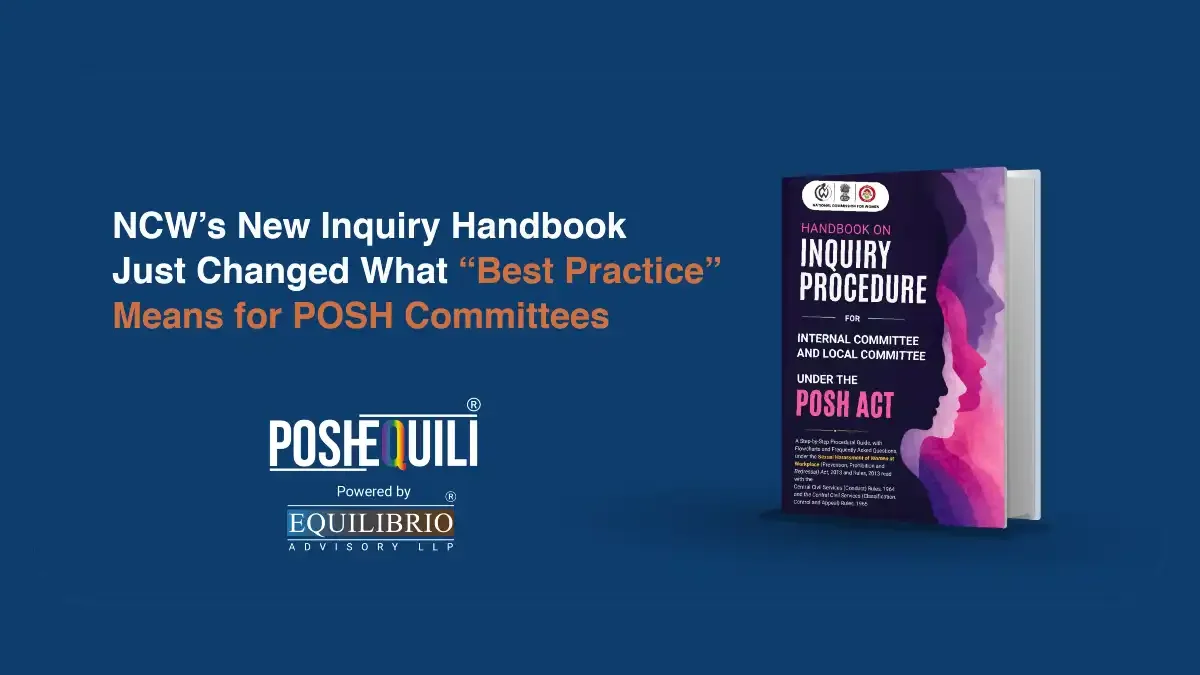
NCW’s New Inquiry Handbook Just Changed What “Best Practice” Means for POSH Committees
For years, Internal Committees have run POSH inquiries roughly the same way: notice, reply, hearings, findings, report. The procedure worked, mostly, because IC members leaned on training, on service-rule conventions borrowed from government inquiry practice, and on their own judgment about how to make a frightened complainant comfortable enough to speak. In July 2026, some of that judgment call became official guidance.
The National Commission for Women has released a new Handbook on Inquiry Procedure for Internal Committee and Local Committee under the POSH Act, prepared by its Legal Cell and launched at a national consultation in Delhi. It does not change the law. But it does something Indian workplaces have needed for a while: it tells Internal Committees, in one place, exactly how an inquiry is supposed to run, and it puts NCW’s weight behind procedural choices that, until now, sat in the grey zone between “legally permissible” and “actually done.”
Here is what changed, and what it means if you sit on an IC, chair one, or are responsible for your organisation’s compliance.
Three procedures, one handbook
One of the most useful things the handbook does is separate three inquiry pathways that are often, wrongly, treated as interchangeable:
- Internal Committee, no applicable service rules. This is the pathway that governs almost every private-sector inquiry in India. Section 11(1) of the POSH Act directs the IC to inquire “in accordance with the service rules applicable to the respondent, and where no such rules exist, in such manner as may be prescribed”, which in practice means the 2013 Rules.
- Local Committee. For establishments with fewer than ten employees, complaints against the employer, domestic workers, and the wider unorganised sector.
- Government Department. Where the respondent is a Government servant, the inquiry runs under the Central Civil Services (Conduct) Rules, 1964 and the CCS (Classification, Control and Appeal) Rules, 1965, with the IC often stepping in as the deemed Inquiring Authority.
Most confusion IC members run into (can a lawyer attend a hearing, is cross-examination a right, what if the respondent stays silent) comes from mixing up which of these three procedures actually applies. The handbook’s contribution is simply refusing to let that happen.
The biggest practical change: how cross-examination is conducted
This is the part worth paying attention to.
The handbook formally endorses a written-questionnaire mode of cross-examination as an alternative to a face-to-face confrontation between complainant and respondent. Where the Committee is satisfied that a witness cannot depose freely in the respondent’s presence, a member puts the questions, records the answers, and the respondent’s right to test the evidence is preserved without requiring the complainant to sit across the table from the person she has accused.
The psychological reasoning here matters as much as the legal reasoning. The first time a complainant has to describe what happened, in a room that includes the person who did it, is not a neutral moment. Direct, adversarial cross-examination can shut a witness down entirely, not because the account is untrue, but because the setting itself is retraumatising. A written mode does not weaken the inquiry. It protects the evidentiary record by protecting the person giving it.
This is not a new idea. The handbook grounds it in a line of cases going back to Bidyug Chakraborty v. Delhi University (2010), later applied in Ashok Kumar Singh v. University of Delhi (Delhi High Court, 2017) and L.S. Sibu v. Air India (Kerala High Court), all of which held that verbal, adversarial cross-examination is not the only permissible method of testing a witness’s evidence. What NCW has done is take a settled but underused judicial position and put it into a procedural handbook that IC members will actually read before a hearing, not after a case goes to court.
The tension this resolves, and it is a real tension, is between protecting the complainant and preserving the respondent’s right to a fair hearing. The written mode does not remove that right. It changes its form: the respondent still gets to test every claim, just not by direct confrontation. Committees that already lean on this approach now have explicit institutional backing for it.
The standards ICs already knew, now reaffirmed
Several fundamentals get restated clearly, which is useful mainly because they are so often misapplied in practice:
- Standard of proof: preponderance of probabilities, not proof beyond reasonable doubt. The Committee asks whether the allegations are more likely than not to be true.
- Timelines: a 3-month limitation period for filing (extendable for recorded reasons), 7 working days to notice the respondent, 10 working days for the respondent’s reply, 90 days to complete the inquiry, and 60 days for the employer to act on the findings.
- Conciliation: available only at the complainant’s written request, only after the respondent’s reply is received, and never on a monetary basis.
- False or malicious complaints: a genuinely high bar. Failing to prove an allegation is not, on its own, evidence that the complaint was false. In our own analysis of over 500 Internal Committee inquiries handled across client organisations, just 1% concluded that a complaint was malicious or false, a pattern the handbook’s own caution directly supports.
None of this is new law. What is new is having it laid out procedurally, with the reasoning behind each step, rather than left to be pieced together from the bare text of the Act.
What this means for employers and IC members:
A few things are worth acting on, not just reading about.
- Review how your IC currently handles cross-examination. If your Committee has been defaulting to face-to-face questioning as the only option, the handbook gives you room, and now institutional cover, to offer a written mode where a witness needs it.
- Treat the 90-day window as more than an administrative deadline. It is also a psychological one. The longer an inquiry drags on, the more a complainant’s memory, confidence, and willingness to continue tend to erode, and the more a respondent’s working relationships deteriorate regardless of outcome. Procedural delay has a cost that shows up in people, not just in paperwork.
- Check your inquiry documentation against the handbook’s templates. Annexures A and B set out structured Complaint Analysis Report formats for IC and LC inquiries respectively, covering constitution details, articles of charge, evidence logs, and article-by-article findings. Worth a side-by-side comparison with whatever format your Committee currently uses.
- Do not assume this replaces training. A handbook tells a Committee what the procedure is. It does not teach a Committee how to actually run a hearing where someone is distressed, evasive, or shutting down, or how to write findings that will hold up on appeal. That is still a skills gap, and it is the one most inquiries actually fail on.
Where the law still needs care:
A caution worth stating plainly: this handbook is guidance, not a substitute for the Act, the Rules, or your organisation’s own service rules or standing orders where they apply. Where certified service rules govern your organisation, those rules control, not the general procedure. And while the handbook cites a consistent line of Supreme Court and High Court judgments, case law is a living thing. Verify current legal position before treating any of this as settled for your specific situation, particularly where a respondent’s status, an unusual jurisdictional question, or an ongoing court matter is involved. If you are unsure whether your current IC protocols reflect this update, or whether your documentation would hold up against the standard the handbook sets, that is a conversation worth having before an inquiry is already underway.
Frequently asked questions
Does an Internal Committee have to allow face-to-face cross-examination?
No. Cross-examination in the adversarial, face-to-face sense is not a matter of right before an IC or LC. Courts have consistently permitted a written-questionnaire mode instead, particularly where direct confrontation would be traumatic for the complainant. This differs from a Government Department inquiry, where cross-examination under Rule 14(14) of the CCS (CCA) Rules is an express statutory right.
What is the timeline for completing a POSH inquiry?
An inquiry is ordinarily completed within 90 days of the complaint, with the employer or District Officer expected to act on the findings within 60 days of receiving the report.
Can a lawyer represent either party during an IC inquiry?
No. Before an Internal Committee or Local Committee, no legal practitioner may represent either party at any stage. This is one of the clearest procedural differences from a Government Department inquiry, where limited legal representation is available in specific circumstances.
Does a complaint that cannot be proven count as a false complaint?
No. A finding that a complaint was false or malicious requires clear evidence of deliberate falsity. The mere inability to substantiate an allegation is not, by itself, evidence of malice, a distinction the POSH Act itself draws under Section 14.
Can conciliation involve a monetary settlement?
No. Monetary settlement can never form the basis of a conciliation agreement under the POSH Act, regardless of which committee is handling the matter.
Newsletter
Signup our newsletter to get update information, news and promotions.
Related Posts

Get in touch with us
Our team is ready to answer all your questions.
Recent Posts
Our Solutions
- POSH Act Compliance Support
- Policy Drafting & Vetting
- Compliance Audit
- Statutory reporting support
- Litigation & risk support
- External Member services
- Inquiry & conciliation support
- Trauma-informed process design
- Support during a live inquiry
- Counselling recommended by the IC
- Leadership & employer
- Training & capability
- Awareness & Culture Tools