

HomeBlogPOSHBlogs | ArticlesKey Questions Emerging from Internal Committee and Employee Awareness Trainings (PART 1)
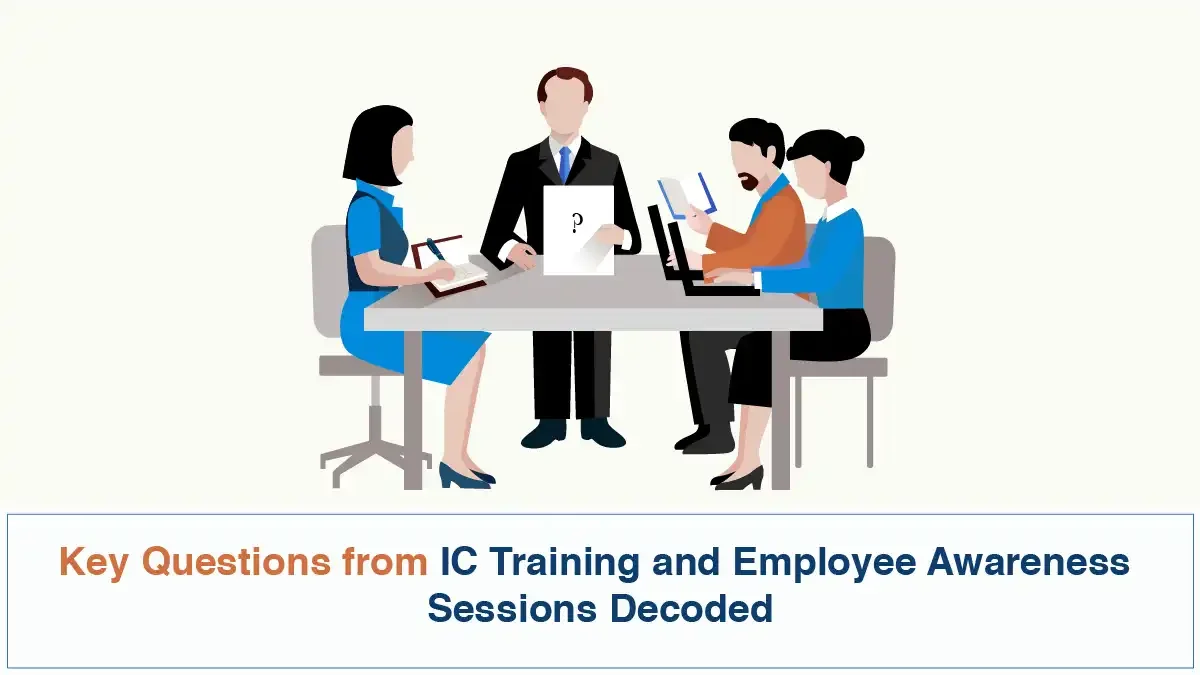
Key Questions Emerging from Internal Committee and Employee Awareness Trainings (PART 1)
Introduction
As a firm dedicated to build a safe and inclusive workplace for all, we at Equilibrio Advisory LLP provide comprehensive trainings on the Sexual Harassment of Women at Workplace (Prevention, Prohibition & Redressal) Act, 2013 (POSH Act) and conduct diversity, equity, and inclusion programs.
The POSH Act is a landmark legislation aimed to provide a safe and secure workplace for women employees in India. The POSH Act was enacted in response to the Supreme Court’s Vishaka Guidelines (1997), which for the first time in the Indian history laid down the framework for addressing workplace sexual harassment. The POSH Act, which is a beneficial legislation, was drafted with the intent of creating safer workplaces, empowering women to report harassment, and hold organizations accountable for fostering a respectful work culture. And it is in the light of this objective that the POSH Act, 2013 read with the POSH Rules, 2013 mandates that organisation having more than 10 employees must constitute an IC that will redress the complaints of sexual harassment at workplace and ensure to conduct timely trainings for their employees and IC members.
As part of our work towards effective implementation of the POSH Act with our client organisations we provide trained External Members (EMs) with intersectional expertise to client Internal Committees (ICs) as well as to support organisations to empower their employees and IC members through training & awareness and capacity building programs. We work with clients across industries ranging from IT and manufacturing to healthcare, education, entertainment, food & beverage, and financial services, bringing legal expertise as well as psychosocial and practical insights to every session.
Despite the diversity of sectors and organizational cultures, we consistently encounter a set of common questions by organisations, IC members, and employees, during the POSH trainings. Through this article we will be looking at some of these questions surrounding POSH Act to spotlight what emerges as gaps in understanding as well as why we need to keep the conversations on the POSH Act, more than a decade after it was enacted.
Frequently asked questions from POSH compliance standpoint by the organisations:
1. Do we need to have an IC if we do not have any female employee?
The POSH Act mandates the constitution of an IC in every workplace having 10 or more employees. And since the POSH Act does not explicitly mention on the gender of the employees, every organisation having 10 or more employees irrespective of whether female employees are currently employed or not, shall constitute an IC. The rationale is that workplaces must remain compliant and prepared, since female employees, interns, consultants, or visitors may join or interact with the organization at any time. And non-constitution amounts to statutory non-compliance attracting a penalty as per Section 26 of the Act (Section 4 r/w Section 6).
2. Who is responsible to submit the annual report?
The POSH Act provides that the Presiding Officer of the IC is responsible for preparing and submitting the annual report in each calendar year. This report must be submitted to the employer and the District Officer, detailing the number of cases filed, disposed of, pending, etc. Delay in filing the annual report would result in penalty up to INR 50,000. Further the employer, is obligated to include this data in their organization’s annual report (Section 21 & 22).
3. Is it mandatory to have posters with IC details?
The POSH Rules requires employers to display at conspicuous places in the workplace the penal consequences of sexual harassment and the order constituting the IC and declare the names and contact details of the committee members. Failure to display such information may be treated as non-compliance with employer duties under the Act (Section 19(b) r/w Rule 13).
Frequently asked questions regarding the role of the IC members during IC trainings:
1. What should IC do after receiving informal complaints?
As per the POSH Act, the IC can only look into complaints of sexual harassment that have been formally addressed to the IC. This has been clarified under Section 9 of the Act, which explicitly states that any aggrieved woman may in writing file a complaint of sexual harassment at workplace to the IC. However, in the event where the IC has received a complaint in an informal manner such as verbal complaints, then in such cases the IC may advice and explain the process of filing a formal complaint to the said aggrieved woman.
2. Can the complainant opt to withdraw her complaint?
Under the POSH Act, there is no explicit provision that bars a complainant from withdrawing her complaint. In fact, the Act recognizes the autonomy of the aggrieved woman in choosing the redressal option for the purpose of initiating inquiry into the complaint. Furthermore, as the IC is bound to follow the principles of natural justice during the inquiry of the complaint, the IC is obliged to respect the decision of the complainant and allow them to withdraw the complaint if they request for the same while the inquiry process is ongoing. However, the IC may record the withdrawal formally and, if necessary, recommend preventive or corrective measures to the employer to ensure a safe workplace.
3. Can any action be taken against the respondent in conciliation?
According to the POSH Act, conciliation is a settlement process where the complainant proposes terms of conciliation to the respondent to settle the matter. Once conciliation takes place, there shall not be any inquiry. However, in case either party or both do not agree to the settlement terms and/or conciliation, then the IC shall respect their decision and initiate the inquiry. Though conciliation terms cannot include monetary settlement or punitive actions to be taken by the IC, if the IC in the process of the initial introductory conversations with the parties identifies that the Respondent has themself admitted to the allegations raised in the complaint, then the IC may recommend certain preventive and corrective actions to be implemented by the employer.
Frequently asked questions regarding filing of a complaint during Employee Awareness Sessions:
1. Can the complainant stay anonymous?
Under the POSH Act, the complainant cannot remain completely anonymous once a formal complaint is filed with the IC or Local Committee (LC) due to the following reasons:
- The POSH Act implies that aggrieved woman must submit their complaint in writing with details such as the allegations, date of last incident, their name etc, which would help the IC or LC to initiate an unbiased inquiry and give the respondent an equal chance to defend themself, in line with principles of natural justice. (Section 9)
- The complainant cannot stay anonymous, but her identity and complaint details are kept strictly confidential within the IC or LC inquiry process. The POSH Act explicitly states that the identity of the complainant, respondent, witnesses and details of the proceedings shall not be disclosed as publication of the same will attract penalty. (Section 16)
2. What is the time limit for filing a POSH complaint?
A complaint of sexual harassment at workplace must be filed within 3 months from the date of incident, extendable up to 6 months if justified. However, if there are multiple incidents, the complaint must be filed within 3 months from the date of the last incident. (Section 9)
3. Can the witness stay anonymous?
As the process of inquiry under the POSH Act is based on the principles of natural justice, both the complainant and respondent have the right to know about the evidence and witnesses who have testified the allegations raised in the complaint. As mentioned above the identity of the witness is protected from being disclosed publicly as well. However, if the witnesses feel uncomfortable in revealing their names to the parties due to fear of retaliation, victimization etc., then in such cases the said witness/s may be given an option of remaining anonymous and any information revealing their identity may be redacted from the documents of the inquiry process.
4. Can a male employee file a POSH complaint?
Under the POSH Act the complainant has been defined as an “aggrieved woman”—meaning any woman, of any age, whether employed or not, who alleges to have been subjected to sexual harassment at the workplace. This makes it clear that only women can file a formal complaint under POSH. Thus, male employees who wish to complaint against sexual harassment at workplace may raise a complaint before other grievance redressal committees constituted in their organisations.
However, if organisations have a gender-neutral POSH policy, then even male employees who have been subjected to sexual harassment at workplace may raise a formal complaint before their IC. And in the instance where the organisation has a gender-specific POSH policy, male employees may raise a complaint in accordance with their code of conduct policy or any other relevant policy that would redress their complaint.
Conclusion
In the light of the objective of the POSH Act, organisations foster a culture of respect and workplace safety through timely awareness programs and trainings for their employees and IC members. During these trainings, key questions frequently arise from organisations, IC members, and employees, reflecting both operational challenges and the need for clarity in POSH compliance. Organisations often seek guidance on structural requirements like the necessity of an IC, annual reporting responsibilities, and awareness displays. IC members raise concerns about handling informal complaints, withdrawal of cases, and the scope of conciliation. Employees, on the other hand, inquire about anonymity, filing timelines, witness protection, and whether men can also file complaints under the Act.
In our experience conducting POSH trainings and acting as EMs across different industries we observed that there are practical doubts while implementing the law that arise. By addressing these questions through interactive methods such as case studies, role plays, and scenario-based exercises, we trainers and POSH Law experts at Equilibrio Advisory LLP, reinforce learning and ensure that the POSH Act is not just a statutory obligation but a conscious, consistent practice. This approach helps organisations build a culture of respect, accountability, and inclusivity, thereby fulfilling the true spirit of the legislation. Check out our FAQ’s to deep dive into the nuances of the POSH Act.
Written by Adv. Bhumika Jain & Adv. KPS Vasantha – Reviewed by Adv. Farzeen Khambatta
Newsletter
Signup our newsletter to get update information, news and promotions.
Related Posts

Get in touch with us
Our team is ready to answer all your questions.
Recent Posts
Our Solutions
- POSH Act Compliance Support
- Policy Drafting & Vetting
- Compliance Audit
- Statutory reporting support
- Litigation & risk support
- External Member services
- Inquiry & conciliation support
- Trauma-informed process design
- Support during a live inquiry
- Counselling recommended by the IC
- Leadership & employer
- Training & capability
- Awareness & Culture Tools